

StatusCake

Facebook Likes Don’t Save Lives

statuscake

Children’s charity UNICEF has hit out with an advertising campaign slamming the way in which Internet users interact with its messaging on social media sites such as Facebook – suggesting that for most users the engagement with the charity starts and ends with the click of a “Like”.

The campaign, created ad agency Forsman & Bordenfors, highlights that although social media campaigns can raise awareness, the fear from UNICEF in Sweden is that members that of the public tend believe that their “Like” creates value – social currency – but it appears to have also contributed to a falling rate in donations being made.   So called “slacktivists” get a sense of accomplishment and participation by liking or sharing a Facebook post or a re-Tweet, but in fact are doing very little at all.  And it’s real hard cash rather than social currency that pays for immunisation and other aid programmes.

Three new adverts ram this message home – making a direct call from the public for cash donations.   In one a 10 year old orphan, left to fend for himself and his younger brother looks to the camera:

“Sometimes I worry that I will get sick, like my mom got sick. But I think everything will be alright. Today, Unicef Sweden has 177,000 likes on Facebook.”

Another of the adverts, ironically being shared and liked widely on social media reads:

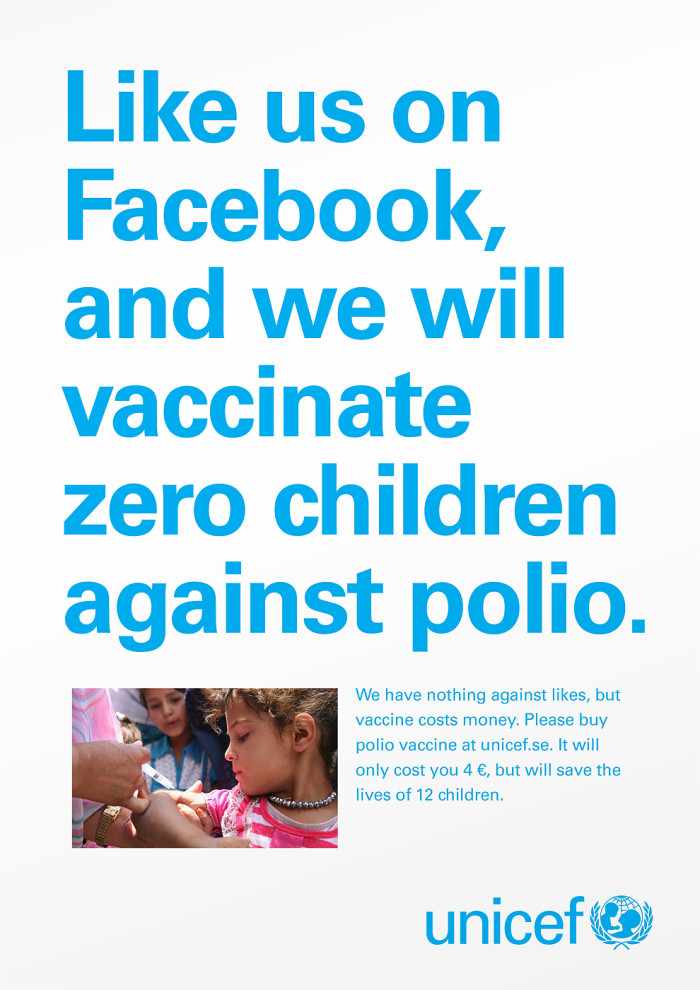
“Like us on Facebook, and we will vaccinate zero children against polio.”

Unicef - Likes Don't save Lives

The concerns of UNICEF mirror those raised by the Kony 2012 campaign; a slick You Tube film which was designed to raise awareness, and ultimately bring to justice, the Ugandan warlord Joseph Kony.   But whilst the You Tube video gains millions of views and was shared widely it didn’t lead to wholesale activism – the lobbying of governments and international organisations.  It ultimately failed.

So the challenge remains for any charitable organisation – spreading the word about your campaigns in a purely superficial way is one thing.  Getting money through the door or getting people to act upon your message in other ways another.

James Barnes, StatusCake.com

Share this

More from StatusCake

What the Namecheap Outage Revealed About DNS Recovery

4 min read On 13th August 2026, a storm knocked out cooling at RadiusDC’s Phoenix data centre, which hosted essential Namecheap operations. To protect hardware from thermal damage, Namecheap took services offline while temporary chillers were brought in. The incident and recovery ran for roughly 30 hours, with Namecheap’s own site unreachable for about 11 hours 42 minutes

Monzo’s Stand-In Held Up on Wednesday. Some Customers Still Had a Bad Day.

3 min read On Wednesday 19 August, Monzo had an outage. DownDetector logged more than 3,000 reports by midday. Monzo’s own statement was direct about what it did next: it activated Monzo Stand-in, its fully independent backup bank, while it investigated an issue affecting customers. By the end of the day, Monzo said the issue was resolved and

What Broke GitHub on August 17 and How Retries Made the Incident Worse

3 min read GitHub’s incident on 17 August 2026 ran from 13:28 to 21:15 UTC, seven hours and forty-seven minutes. At peak, web and API traffic saw error rates of around 20%, while archive and raw-content downloads reached roughly 50%. SAML and OIDC authentication, SCIM and Team Sync were affected alongside Git operations, Actions, Pages, Issues, Pull Requests

Automate StatusCake Monitoring with viaSocket

3 min read Adding a new website, launching a customer portal, or handing a service to a new team should be straightforward. Setting up monitoring is part of that job, but it is easy for a manual step to be missed when information is spread across several systems. StatusCake now integrates with viaSocket, giving teams a way to connect

Website Monitoring Checklist: What to Track Beyond Uptime

7 min read A website may be standing and still be in trouble. It may answer a request, return a cheerful 200 OK, and yet load slowly enough that visitors begin to lose patience. Its certificate may be nearing expiry. Its domain records may have changed. A server may be filling its disk in the background, patient and

Want to know how much website downtime costs, and the impact it can have on your business?

Find out everything you need to know in our new uptime monitoring whitepaper 2021

*By providing your email address, you agree to our privacy policy and to receive marketing communications from StatusCake.